Table of Contents
- A Motorcycle Builder Who Knows What He Wants
- People Who Follow Their Calling
- Why Can't I Be Like Them?
- The Web of Meaning, Unravelled
- The Double Hollow
- Career as Cage
- The Ones Who Have a Calling
- How We Walked Into the Cage Without Noticing
- When External Pressure Becomes Inner Voice
- The New Religion of Self-Improvement
- Career vs. Calling
- Weaving Your Own Web
A Motorcycle Builder Who Knows What He Wants
Lately I've been watching a lot of Zhang Xue's videos. As I write this, racer Debise, riding a Zhang Xue motorcycle, has just won again at the Czech round of WorldSSP, securing his fourth victory of the season. In a sport long dominated by Japanese and European manufacturers, a Chinese brand has carved out a place of its own. That's a remarkable achievement.
Zhang Xue became a motorcycle mechanic's apprentice at fourteen. He went on to be a stunt rider, a racer, a mechanic, and worked in factory-level whole-vehicle R&D. As a young man, he dreamed of becoming a professional rider; he even reached out to a TV reporter to get himself featured on camera, hoping for the exposure that might catch a racing team's eye. Eventually he realised he didn't have the talent to be a racer, but he stayed in the field. He founded his own brand and developed engines and complete motorcycles from scratch. I've seen footage of his livestreams: when a customer describes a problem, he can diagnose the fault just by listening to the engine. He never finished high school. He ran on passion alone, drilling into the same thing for an entire lifetime. Going from a complete outsider to achieving that level of technical mastery, becoming a genuine expert in his domain, is deeply admirable. But what truly moves me isn't the accolades. It's that he knew, very early on, what he wanted, and then spent years doing one thing to its absolute limit. That steadfastness, that willingness to pour everything into what he loves without calculating short-term gains, is a rare quality.
Why Can't I Be Like Them?
I spent a long time asking myself: why am I not like Zhang Xue? He has a clear goal. He can throw himself entirely into one thing, find belonging in it, find something that feels like an inner calling. I can't treat my career as a calling. As an engineer, I enjoy my work, but I don't feel that the industry I'm in right now is the thing I want to devote my entire life to. What went wrong? Was I born without grand ambitions, or did I simply end up in the wrong field? For several years, every time I looked back at year's end, I'd go through another round of self-doubt, and I tried exploring other directions. But the question still has no answer.
The Chinese say that by forty, a person should be free of confusion. Yet as I barrel towards forty, I find myself more confused than ever. Choices I once took for granted, I now question one by one. I've been reading Yang Zhao's The Truth of Modern Society, which talks about Max Weber's theory of how the mordern society has been shaped in this way and the struggles of modern people, and I think I'm beginning to have a faint understanding of where this confusion comes from. And I'm starting to believe it isn't just my problem, as most modern people are probably stuck in the same place. The only difference is whether they've realised they're in it.
The Web of Meaning, Unravelled
Weber believed that human beings live inside a "web of meaning." This web gives people direction—it tells them what matters, what's worth pursuing, what can be let go. But the problem with modern society is that this web has been dismantled, strand by strand, by rationalisation. Weber called this process Entzauberung (disenchantment): the world is no longer mysterious; everything can be calculated, explained, and handled through technique.
This process began during the Renaissance, when people started using reason to investigate the arts of living. It continued through the Reformation, when Martin Luther demanded that each person read the Bible for themselves and understand faith through reason. Then came the Scientific Revolution, which illuminated every corner of the natural world. It went as far as Freud, who turned humanity's last irrational territories, such as dreams, hallucinations, and the unconscious, into objects of rational analysis. As Yang Zhao puts it precisely: the domain of reason kept expanding until there was no territory left for mystery.
Disenchantment made the world efficient, controllable, predictable. But the side effects followed: when everything has a technical answer, people lose the very capacity to imagine what life might be for. Yang Zhao, drawing on Weber's insight, offers a comparison: primitive man's stone axe was hand-crafted; his quarry was hunted by his own hand. He mastered very few tools and little knowledge, yet he genuinely controlled his own life. Beyond the horizon of what he could understand lay darkness, things opaque and inexplicable. But it was precisely that mystery which gave him the freedom to imagine, to ask what it means to be alive.
The Double Hollow
And what about modern people? Modern society has created a vast, comprehensive repository of knowledge, which gives us the illusion that we can know everything, while confusing us about a crucial fact: we don't actually possess or know all this knowledge at all times; it's merely that if we wanted to know something, the answer would be there. And what is its real effect? It stops people from asking questions, or rather, makes it impossible for anyone to wonder, to re-explore for themselves, to imagine how the universe came to be. The origins of the universe, how the body works, how society is organised: the answers are all sitting there waiting for you. You don't need to imagine. And under the weight of authority, many new ideas face the risk of being suppressed. The meaning of life becomes something decided for you by others, rather than something you groped towards in the dark and came to understand on your own.
At the same time, our actual control over our lives may be far less than a primitive person's control over a stone axe. The purchasing power of currency, the chip in your phone, the food supply chain: the vast majority of what sustains our daily lives has been designed by others using reason and handed to us. Yang Zhao calls this the "double hollow": we neither truly command the tools on which our survival depends, nor do we have the space left to imagine that life might carry some larger meaning.
Career as Cage
This hollowness seeps into every corner of daily life. The reason modern society can sustain itself at such a colossal scale is its relentless pursuit of efficiency: it's very good at answering "what's the most effective way to do this?" but never asks "what's actually worth doing?" Weber called this the triumph of instrumental rationality over substantive rationality: we no longer ask "why should we do this?" Instead, we only ask "how do we do it at the lowest cost and highest output?"
Looking back, from childhood onward, the web of meaning was always woven for us by others: schools told us what to study, parents told us what's safest, the market told us what pays best. We grew accustomed to measuring every life choice by efficiency, learning to use the smallest lever to move the greatest weight. This way of thinking is familiar to us, and it's what society rewards. But most people never got the chance to weave a web of meaning for themselves. By the time you finally look up, you find you've accumulated plenty of thread over the years, yet you've lost the ability to imagine what the web should look like, and the courage to weave it with your own hands.
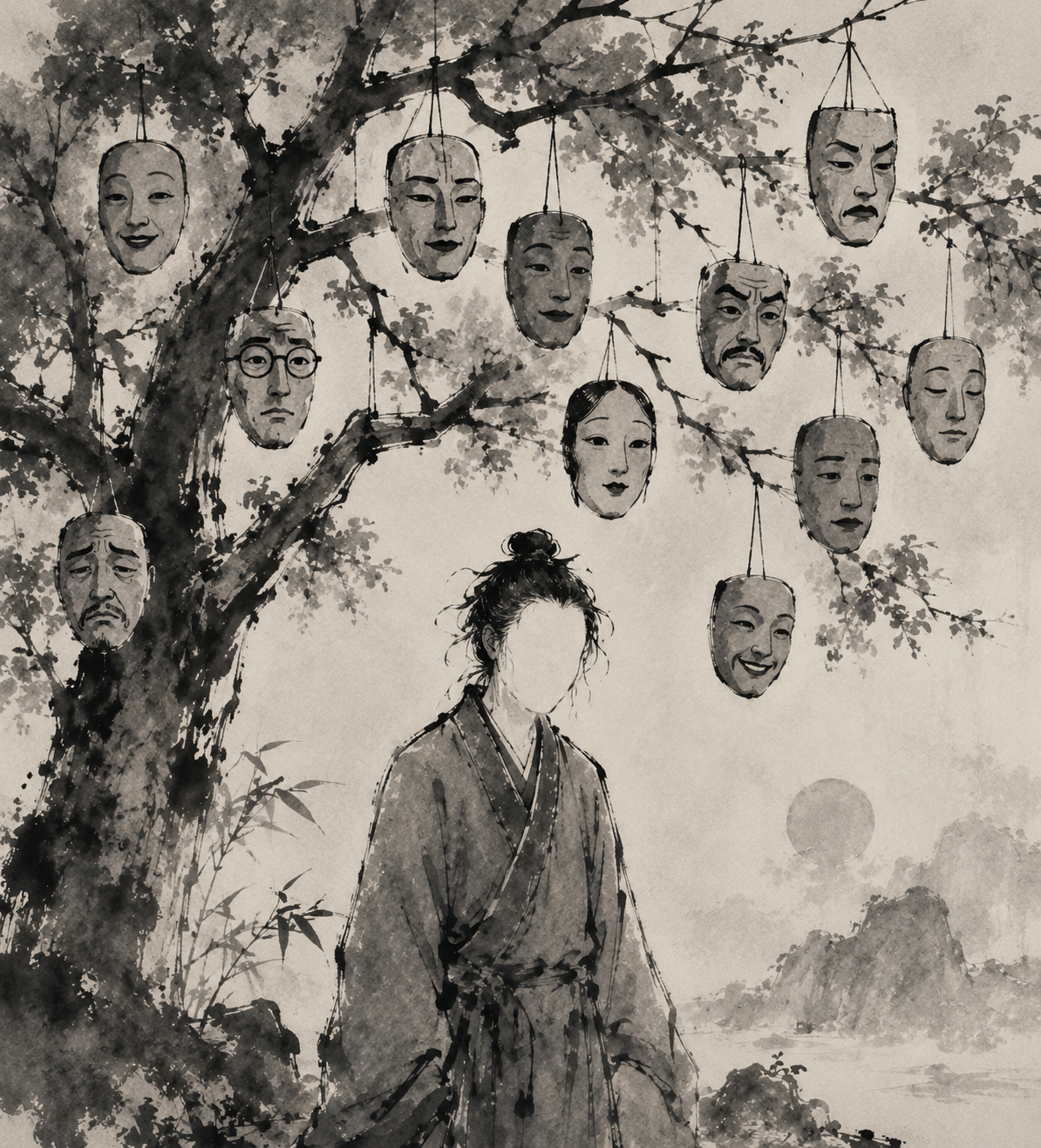
To achieve this absolute efficiency, society invented extreme specialisation and bureaucracy. Within this system, no one can command the whole the way a primitive person commands a stone axe. Instead, each person is sliced into a narrow cog within a specialised domain. It is precisely this slicing that defines what most of us know as a "career." We sell our labour and specific skills within a narrow subdivision in exchange for a salary and a sense of security. Work becomes a means of acquiring the resources for survival. The system only asks you to hand over the part of yourself that holds "professional qualifications", while your emotions, personality, and thinking, which cannot be priced, are excluded. This fragmentation forces us to constantly switch masks depending on the external environment, and even to hide away the parts of ourselves that don't produce "utility," until we completely lose any unified inner self. That's why a "career" so often comes with a deep sense of hollowness, and it's probably the root cause of the pervasive exhaustion felt by modern people.
The Ones Who Have a Calling
But Weber reminds us that beyond career, there exists something called Beruf, or calling. A calling disregards utility. It's a summons that arises from deep within, making you want to pursue a thing as an end in itself. In Weber's view, the birth of the early capitalist spirit was intimately connected to this sense of calling. A group of Calvinist Puritans, answering God's call and seeking to prove their worth before Him, poured all their passion into work. They created wealth yet did not wallow in its pleasures; instead, they reinvested everything back into production. This near-fanatical devotion formed the original accumulation of capitalism. The reason I admire Zhang Xue is precisely this: in a modern society that worships efficiency and fragments people into pieces, he has, almost miraculously, preserved a wholeness, a devotion that belongs to calling.
How We Walked Into the Cage Without Noticing
The strange thing is: how did we sleepwalk into the cage of modern society? Nobody ever forced you in. But most people didn't even realise they were making a choice, because the cage looks so much like a clearly marked map. Study, get a degree, find a good job, keep climbing. There are signposts at every interval and footprints of those who came before, telling you where to go next. More importantly, the system has already figured out the most troublesome thing for you: where to direct your effort, what success looks like, where the next checkpoint is. And so the question that truly frightens people can be endlessly deferred: Where am I actually going? What do I actually want? That "certainty" itself is an irresistible temptation.
Living in modern society, everyone seems to have no choice. As Marx would put it, capital has long since quietly shifted the cost of self-renewal onto workers: what to learn, how fast to learn it. On the surface it's your own decision, but in reality the market is deciding for you. Everyone is swept along, running forward, terrified that the moment they stop, they'll be left behind.
When External Pressure Becomes Inner Voice
At the macro level, this may be a reality beyond any individual's power to change. But what puzzles me more is that we haven't just accepted this external pressure; we seem to have internalised and even glorified it. Take myself: a few years ago, I was obsessed with those "productivity influencers." They trumpeted the Silicon Valley elite lifestyle: up at five a.m., gym, precise time management, bragging about how extreme self-discipline could make every single day efficient and fulfilling.
For a while, I tried to imitate them. I forced myself to go to bed early and drag myself out of bed at five. I lasted less than a week before giving up completely. My conclusion at the time: clearly my willpower just isn't strong enough; I'll never be as disciplined as those successful people. I sank into deep self-blame and anxiety, and it tortured me for a while before I slowly made peace with myself and accepted that my current routine is the most comfortable and natural state for me.
Looking back now at those days of fighting with myself, I start to wonder: why did I internalise this external pressure of "pursuing absolute efficiency" and turn it into my own voice, then use it to constantly judge myself? This voice isn't like a short video on your phone: if you don't like a video, you can just swipe past it. But the voice inside you is pervasive. It pops up when you're resting, when you're daydreaming, at some random, unguarded moment, accusing you of not doing well enough today, accusing you of not seizing the time to learn a new skill, of not properly planning your day.
How exactly does external pressure become internal self-attack? What starts as "the workplace requires me to learn new skills" gradually morphs into "if I don't learn, I'm worthless." What starts as "I need to plan my career" gradually morphs into "not having a plan means I'm irresponsible." Market demands put on the costume of morality and become your own harsh demands on yourself. You no longer feel that the external environment is pressuring you; instead, you feel "it's me who isn't good enough." This transformation is the most insidious, the hardest to detect. It probably happens in daily life, at work, while scrolling through short videos, and gradually, imperceptibly, that harsh, demanding voice sounds exactly like your own.
The New Religion of Self-Improvement
Sometimes I wonder: is this obsession with "self-improvement" a new religion that our era has manufactured for itself? Weber said that after disenchantment, the space once filled by religion was emptied out. But humans need a sense of meaning, so we found a substitute: continuous progress, continuous learning, continuous self-optimisation. This substitute has its own commandments (no slacking off, you must have ambitions), its own guilt (is not learning today a form of moral decay?), and even its own rituals (annual reviews, reading notes, retrospectives).
The old religion promised you heaven after death. The new religion promises you a promotion and a raise in five years. The structure of faith is strikingly similar, only now there's no priest to offer free absolution. Instead, the "altars" are built by career coaches of every stripe, who solemnly lead their lost flocks through lessons on managing up and accommodating down, teaching you how to break through ceilings and reach the pinnacle of your career. And when anxiety arrives, along with the "guilt" of not having reflected or progressed today, you either pay a therapist for a modern dispensation, or you struggle through the inner torment until you learn, painfully, to make peace with yourself.
Career vs. Calling
But for the vast majority of people, "self-improvement" chases career, not calling. The direction of a calling comes from within; the direction of a career is set by the system. When self-improvement serves career maintenance, the force driving you is no longer yourself; it's the market. The market's logic is efficiency; efficiency demands constant updating. The machine of society needs every component to keep upgrading, and so the pressure, once internalised, becomes each person's relentless self-prodding: I must improve, I must keep up, I must not fall behind.
But keep up with what? That's the most vexing part. Market hotspots never wait: data science had its moment, then AI arrived, and nobody knows what's next. You've barely caught up with one wave before the current has already shifted direction. The harder you chase, the more you feel you're falling behind, because the direction was never in your hands.
Here's my humble opinion. I think the root of the problem is this: without your own web of meaning, you have no anchor. Without an anchor, what to learn and where to go are always determined by forces outside you. The more we learn, the closer we don't necessarily get to our own answer, because we may have rarely, or never, looked deep inside ourselves to ask what our heart truly longs for.
Weaving Your Own Web
Figuring out your own "web of meaning" is probably a lesson none of us can skip. With it, you at least know where you're heading. Without it, you can only chase wherever the wind blows.
Thinking about this, I feel that "learning" itself can be split in two. One kind is for making a living, perfectly normal, nothing to be ashamed of. The other is for your own heart and curiosity, to keep your livelihood from swallowing you whole. The first keeps you in the market; the second keeps you from belonging entirely to the market.
The ancients said that at forty, one is free of confusion, probably because back then, by forty you'd experienced most of what life had to offer, and the world didn't change much. Now it's the opposite: forty has become the most confusing age. Degree earned, job stable, house bought, family started. It's as if you've cleared every preset checkpoint of life, one by one. Then you stand there and suddenly realise that no one has set the next one for you. Everything before was external: your parents' expectations, school's gatekeeping, society's roadmap. Someone else's script has ended, and now you have to walk forward on your own, but you sadly discover you never practised doing that. Perhaps what you lack is exactly that sense of calling: something that grows from inside you, something you want to spend a lifetime drawing closer to.
The reason I admire people with a sense of calling, like Zhang Xue, has nothing to do with whether they're successful in any conventional sense. It's because they genuinely know what they're chasing. For me, sustained reading and writing is probably that thread, still hard to see clearly, but already beginning to show itself. I want to understand how modern society works, and I want to understand how I was shaped into the person I am today. Even approaching forty and still very much "confused," at least I've begun trying to weave that web of my own. I'm grateful to the younger me who never stopped being curious about the world.
May 2026, Bristol